En
L
M
S
0

Pema Lingpa Lineage

A Concise Presentation of the Origin and Defining Features of the Treasure Teachings

1. The Source of the Common Teachings

All Buddhas appear in the world in order to tame the ignorance, craving, and grasping of sentient beings. In this degenerate age, when beings possess little merit and it is difficult for them to encounter the transforming influence of the Dharma, the incomparable Sage, the Fourth Guide of this Fortunate Aeon, Buddha Śākyamuni, was born in the Sahā world in accordance with his boundless compassionate aspirations made in the past, in order to guide beings burdened by suffering and negative karma.

As stated in the Karuṇāpuṇḍarīka Sūtra:

“Good son, bodhisattva mahāsattvas, by the power of their original aspirations, take birth in pure and excellent realms; and likewise, by the power of their original aspirations, they take birth in impure realms. Why is this so? Because bodhisattva mahāsattvas have perfected great compassion, they take birth in such degenerate and afflicted worlds.”

After the Buddha was born, he guided sentient beings through such enlightened deeds as renunciation, ordination, and attaining awakening. Over the course of forty-nine years, in order to open and illuminate the minds of beings and bring them to the perfection of great awakening, he taught immeasurable skillful means and Dharma doors, revealing the nature of mind. This is the fundamental source of all teachings.

2. The Source of the Uncommon Treasure Teachings

Thereafter, for the benefit of future sentient beings, many teachings of both Sūtra and Mantra, such as the Avataṃsaka Sūtra, were entrusted to devas, nāgas, yakṣas, and others, who were charged with guarding them well. It was also prophesied that in the future, pure and noble beings¹ would gradually receive, reveal, uphold, and widely propagate them.

In particular, in order that the victory banner of the authentic Dharma might remain raised high, and that sentient beings might continually receive benefit, the Buddha, in accordance with his former aspirations, manifested through boundless wisdom, courage, and heroic strength as the supreme emanation, Guru Padmasambhava. After the parinirvāṇa of Buddha Śākyamuni, Guru Padmasambhava guided those to be tamed through the skillful means of both Sūtra and Mantra instructions.

As stated in the Mahāparinirvāṇa Sūtra:

“At that time, disciples such as Kātyāyana, Aniruddha, Cunda, and Ānanda surrounded the Blessed One. The Blessed One said to the disciples: ‘After my parinirvāṇa, do not give rise to sorrow or distress. After eight years have passed, one of supreme activity will be born in the world from the Immaculate Ocean…’”

As stated in the Sūtra of the Prophecy of the Crown Ornament:

“After I am no longer manifest in this world,
When two times four years have passed,
In the northwestern direction of the land of Oḍḍiyāna,
On an island in Lake Dhanakośa,
One surpassing all noble beings will be born.”

As stated in the Tantra of the Perfect Gathering of All Meanings:

“After I have passed into great parinirvāṇa,
When ten years, less two, have gone by,
The supreme lord surpassing all beings of the world,
Known in Oḍḍiyāna as Padmasambhava,
Will be born from a lotus.
I now prophesy that he will spread the Secret Mantra.”²

As stated in the Sūtra of Golden Light:

“This Padmasambhava is praised and revered by all Buddhas of the past, all Buddhas of the present, and all Buddhas of the future.”³


Based on the prophecies above, eight years after the Buddha manifested parinirvāṇa, there was a king of Oḍḍiyāna named Indrabhūti. He delighted in virtue and generosity and had deep faith in the Buddhadharma. However, he had no son to inherit the throne. When all the jewels stored in the royal treasury had been completely exhausted through his acts of generosity, he followed the advice of his ministers and set sail upon the ocean in search of treasure.

After obtaining a wish-fulfilling jewel, on his journey home he saw an immense lotus floating upon the surface of the sea. Upon it was a naturally born child. The king brought the child back to his kingdom, enthroned him as crown prince, and gave him the name Padmasambhava, “Lotus-Born.”

Thereafter, as the prince gradually grew up, he manifested such enlightened activities as holding the royal throne, displaying princely conduct in the palace, renouncing worldly life, and listening to the Dharma. He relied upon Ānanda, foremost in hearing, and learned all the teachings spoken by Buddha Śākyamuni. He also relied upon many spiritual masters and received both common and uncommon secret oral instructions.

In the Magadhīra Cave on Mount Potalaka, the sacred abode of Avalokiteśvara, he received all the instructions of Amitābha Buddha from the glorious wisdom ḍākinī. He was enthroned as lord of the Dharma, and he compiled all the tantras into written form. For the benefit of future beings, he concealed them as treasure teachings, entrusted them to the guardians of the Dharma, and sealed them with blessings and aspirations.⁴

Thereafter, Guru Padmasambhava successively manifested many emanations and took birth in various places. In accordance with the roots of virtue, merit, and circumstances of beings to be tamed, he performed the enlightened activities of protecting and spreading the Buddhadharma. These emanations include the great master Nāgārjuna, clearly prophesied in many sūtras such as The Sūtra of the Licchavi Youth Good Vision of the World, The Questions of the Licchavi Youth, and The Great Dharma Drum Sūtra; Bodhisattva Śāntideva, author of The Way of the Bodhisattva; the great siddha Ghaṇṭapāda; the great master Nāropa, guide of the Mahāmudrā teachings; the accomplished master Kṛṣṇācārya; and other realized masters.⁵ These accounts should be understood in detail from the extensive biographies of Guru Padmasambhava and from the various treasure scriptures.

In brief, after the parinirvāṇa of Buddha Śākyamuni, Guru Padmasambhava manifested vast enlightened activities of protecting and propagating the Buddhadharma through great wisdom, great compassion, and great power. Above all, his kindness toward the Mahāyāna teachings of Buddha Śākyamuni is unparalleled.

As stated in The Questions of the Nāga King Sūtra:

“The inexhaustible great treasury through which the continuity of the Three Jewels remains unbroken;
The inexhaustible great treasury through which immeasurable Dharma is realized;
The inexhaustible great treasury that fulfills all sentient beings;
The inexhaustible great treasury equal to space—
These are the four inexhaustible great treasuries.”

In order to fulfill the aspirations of all sentient beings who seek awakening through the inexhaustible great treasury of the Buddhadharma, Guru Rinpoche manifested in the form of Nāgārjuna and brought forth many sūtras and tantras, principally the Avataṃsaka Sūtra, from the nāga realm, mountain cliffs, temples, and other places. Likewise, manifesting in forms such as Bhavabhaṭṭa and Nāropa, he successively brought forth unsurpassed Secret Mantra teachings such as the Guhyasamāja, Kālacakra, and Hevajra tantras.

Later, during the Tang dynasty, the Tibetan king Trisong Detsen ascended the throne at a young age and possessed extraordinary faith and devotion toward the Buddhadharma. After many difficulties, he invited Guru Padmasambhava to Tibet to spread the Dharma. Guru Rinpoche then established Samye Monastery, the first monastery in Tibet complete with the Three Jewels. From that time onward, both the Sūtra and Mantra teachings of the Buddhadharma began to spread throughout Tibet.

3. The Characteristics of Treasure Teachings

At that time, Guru Padmasambhava, the Second Buddha of Oḍḍiyāna, observed the karmic connection between the Buddhadharma and sentient beings. In order to ensure that the authentic Dharma would not be destroyed by non-Buddhist forces or obstructing māras, and so that the greatest possible benefit could be brought to future beings, he, together with the wisdom consort Yeshe Tsogyal and disciples such as the great translator Vairocana and the monk Namkhai Nyingpo, concealed all the oral instructions in various places throughout the world, principally in Tibet.

He entrusted these teachings to Dharma protectors, instructing them to guard them strictly. He also sealed them with blessings, aspirations, and prophecies, so that in the future, all beings with the appropriate karmic connection could receive benefit. This is the well-known source of the treasure teachings.⁶

Concerning the prophecies of treasure teachings, many sūtras—such as The Sūtra of the Samādhi in Which the Present Buddha Abides in Awakening and The Sūtra of the Samādhi That Gathers All Merit—explain in detail the scriptures of treasure teachings, the treasure caskets in which they are concealed, the treasure sites such as mountains, forests, and space, the Dharma protectors who guard them, the treasure revealers who open them, the benefit they bring to sentient beings, and the qualities by which they cannot be destroyed by non-Buddhist forces.⁷

In summary, the treasure teachings concealed by Guru Padmasambhava are generally divided into two main categories: material treasures and mind treasures.⁸


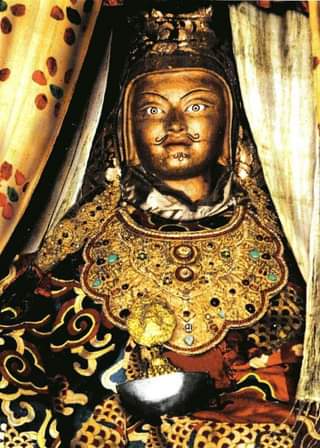
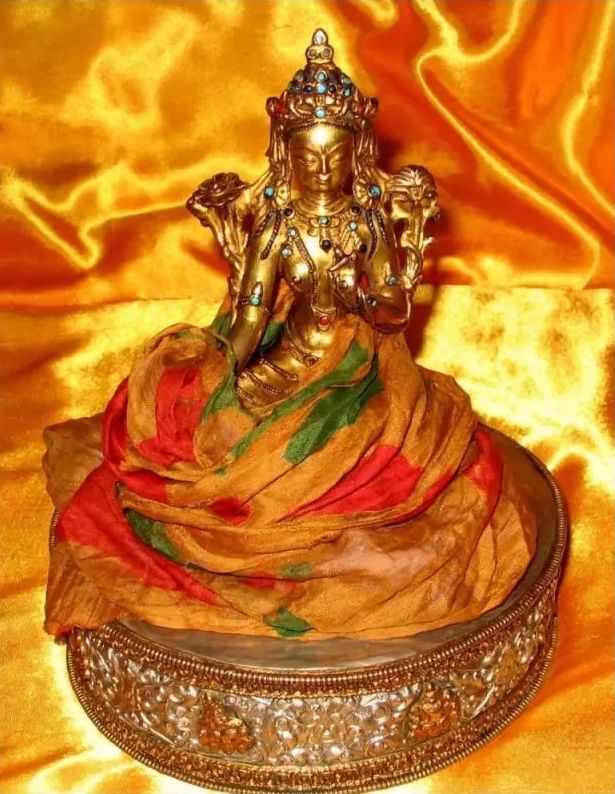
From left to right: A “liberation upon seeing” Tārā statue personally crafted, consecrated, and blessed by Guru Rinpoche, then bestowed upon the wisdom ḍākinī — a terma revealed by Chokgyur Lingpa; and a terma statue of Guru Padmasambhava — from the First Dzongsar Rinpoche.

Material Treasures

Material treasures include many kinds of objects, such as scriptures, statues, ritual implements, medicines, and so forth. They are concealed in places such as space, mountains and rocks, stupas, rivers, trees, and other locations, and are guarded individually by various Dharma protectors according to their samaya pledges.

Among these, the script of the treasure scriptures is composed of combinations of Sanskrit, Tibetan, nāga, non-human, and ḍākinī scripts. This is known as ḍākinī symbolic script. Apart from the authentic treasure revealers prophesied by Guru Rinpoche, no one can recognize or decipher it. Therefore, there is absolutely no danger that it can be destroyed by non-Buddhist forces.

Mind Treasures

Mind treasures are teachings that Guru Rinpoche and the Buddhas personally transmitted and blessed. Through their aspirations, the emanated treasure revealers among their disciples would, at the appropriate time and place, and in the presence of the destined beings to be benefited, write them down through the miraculous power of unfailing recollection. The beings to be benefited by these teachings were also clearly prophesied in detail.

In brief, mind treasures are the essential pith instructions of oral guidance, expressed through the experience of realization.

Among all treasure teachings, mind treasures, secret mind treasures, and pure vision teachings are considered the most supreme, while material treasures are regarded as secondary.

Among all treasure revealers, those who possess the three kinds of teachings—Guru Yoga, Great Perfection, and Avalokiteśvara practice—are known as great treasure revealers. Other treasure revealers are considered secondary. Thus, it is said that there are 108 great treasure revealers, 1,000 lesser treasure revealers, and countless minor treasure revealers.

These sublime treasure teachings have not only been upheld and propagated by the lineage disciples of the Oḍḍiyāna Ācārya Guru Padmasambhava, but have also been joyfully received, practiced, and spread by great masters of the later New Translation schools.

For example, great masters of the Sakya tradition, such as the venerable Lodrö Gyaltsen and the noble Künga Doringpa, devoted themselves to propagating teachings such as The Realization of True Meaning, Vajrakīla, and Great Perfection instructions.

Je Tsongkhapa, the great master of the Geluk tradition, in order to ascertain the true meaning of the nature of reality, relied upon the treasure revealer Karma Vajra and received from him The Oral Instructions of Vajrapāṇi, which were later included in The Collected Works of Je Tsongkhapa. In particular, the Fifth Dalai Lama, who holds an eminent position within the Geluk tradition, was himself a treasure revealer who revealed treasure teachings.

The Third Karmapa, Rangjung Dorje, in addition to upholding the tradition of the Kagyü school, was himself a treasure revealer and an emanation of the great paṇḍita Vimalamitra. He revealed profound treasure teachings such as The Karma Nyingtik, the essence of the oral instructions of the Great Perfection.


The Mantra of Liberation Upon Seeing
Revealed from a rock treasure in the 17th century by the tertön Minjur Dorje, this mantra was written in the symbolic script of the ḍākinīs.
Whoever sees, recollects, praises, or makes offerings to it will receive the following benefits:
  1. The five poisons will be purified.
  2. One will not fall into the three lower realms.
  3. One will be freed from the lower realms.
  4. One will be freed from the ripening effects of karma.
  5. One will be freed from the terrors of saṃsāra.


In short, the terma lineage is not exclusive to the Old Translation School. All traditions of Tibetan Buddhism have, in one way or another, been protected, sustained, and brought to flourishing through the treasure teachings.

Thus, the stream of terma teachings is not merely the Dharma tradition of the victorious Nyingma school; it is the very essence of all Sūtra and Mantra teachings of the Land of Snow, and the vital life-pillar of the entire Buddhist dispensation.

Notes

① This refers to those whose karma is pure, and also to noble beings who have attained the fruition of realization.
② Literally: “I now prophesy that this great master will spread the Secret Mantra Vehicle.”
③ This means that the Guru is an emanation of the Buddhas of the three times.
④ In all treasure teachings, there are verses entrusting the teachings to Dharma protectors for safeguarding, as well as aspirations and prophecies concerning who will reveal them in the future.
⑤ The figures listed here are all based on treasure prophecies, mainly from The Collected Works of Apang.
⑥ This refers primarily to the main streams of treasure teachings. There are also Dharma streams of great masters such as Vimalamitra and Vairocana, which are not discussed here.
⑦ These are recorded in the Tibetan Kangyur; the Chinese sources are not clearly known.
⑧ According to different prophecies, there are also classifications such as the Five Great Treasures, sixteen categories of treasures, and eighteen categories of treasures. Here, the explanation is given in general terms.
⑨ There is also the explanation of “Nyingtik,” or Heart Essence. Here, the explanation follows the treasure teachings of the Guru Father and Mother.

This article is excerpted from The Biography of the Nelong Guru Father and Mother, written by Vairochana Abhayajñāna Rinpoche.
Source: Aming Tibetan Blog — Nyingma Terma and Dzogchen
http://blog.sina.com.cn/aming88